
Chapter 3
THE SMART PRODUCTIVE KUSHET (ቁሸት)
WHAT CAN CUSTOMERS DO WITH IT?
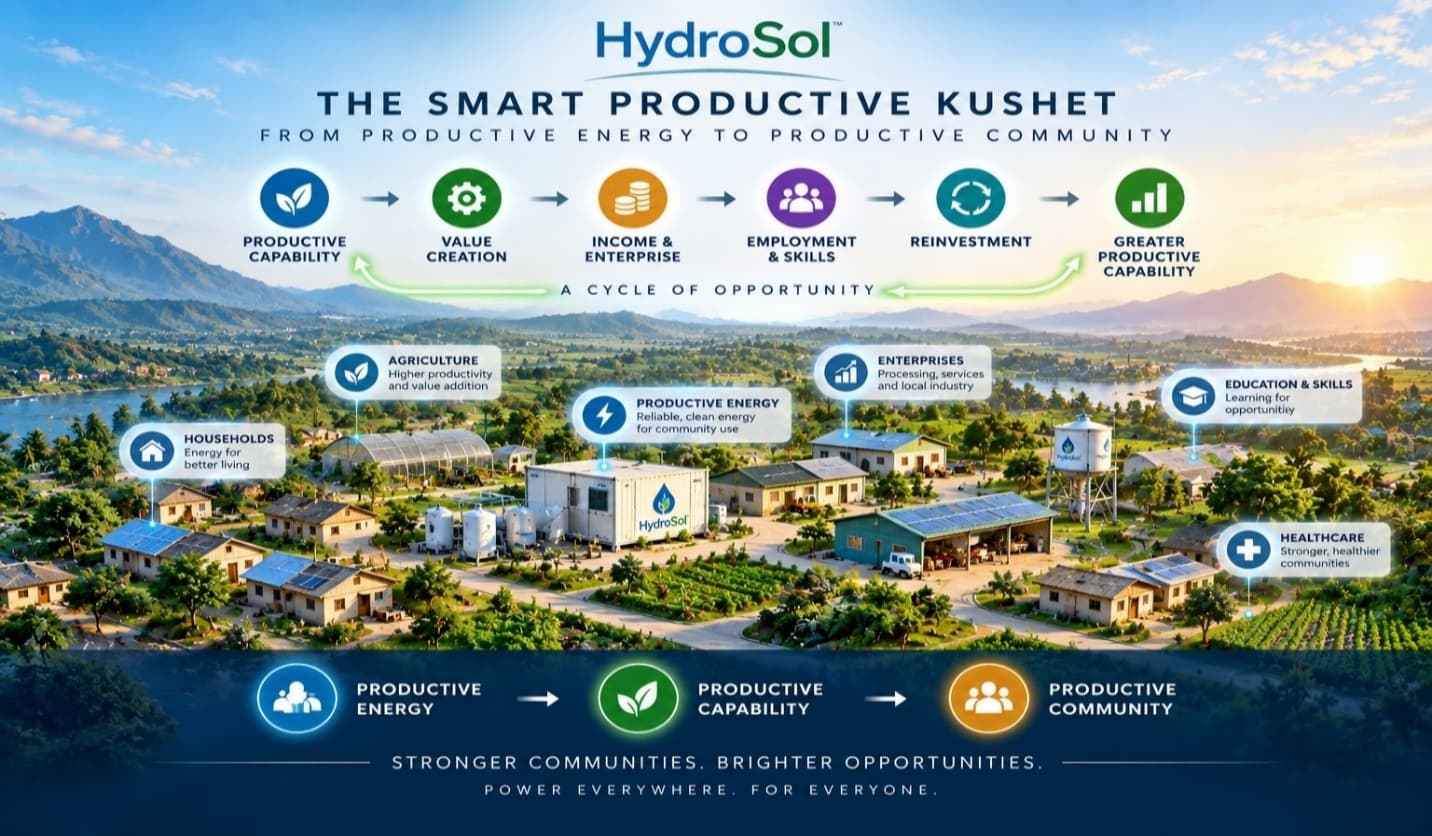
3.1 FROM PLATFORM TO PRODUCTIVE COMMUNITY
Chapter 2 introduced the HydroSol Platform and the distributed Productive Energy capability it is designed to provide. The next question is what happens when that capability reaches people, enterprises and productive activity.
A Smart Productive Kushet begins not with technology, but with the economic potential already present within a community:
People | Skills | Resources | Enterprises | Institutions | Demand | Market Opportunities
HydroSol introduces Productive Energy as an enabling capability within that environment.
Technology must adapt to productive life rather than requiring productive life to adapt to the technology.
The objective is to strengthen the ability of households, entrepreneurs and enterprises to produce, process, preserve, transport, trade and create value.
Productive Energy → Productive Capability → Productive Community
3.2 FROM ENERGY TO ECONOMIC ACTIVITY
Productive Energy acquires greater economic significance when it enables activities that create products, services, income and market participation.
Potential applications may include:
Agriculture | Processing | Refrigeration | Workshops | Healthcare | Digital Services | Mobility | Manufacturing | Local Enterprise
Different markets will develop different combinations according to customer demand, local resources, skills and commercial opportunity.
The economic pathway can therefore extend from energy into productive activity:
Productive Energy → Productive Activity → Products & Services → Revenue & Income → Reinvestment → Market Growth
The objective is not energy consumption alone. It is the economic activity that useful energy can enable.
3.3 PRODUCTIVE USERS AT THE CENTER
The Smart Productive Kushet does not treat communities simply as beneficiaries.
It creates an environment in which:
Entrepreneurs | Farmers | SMEs | Cooperatives | Youth Enterprises | Women-Led Enterprises | Productive Households | Local Service Providers
can become customers, producers, service providers and market participants.
Productive Participation Rather Than Dependence
Productive users are not simply recipients of energy; they are potential creators of products, services, income and economic value.
3.4 LOCAL VALUE CREATION
Where productive capability supports viable economic activity, value can circulate locally through income, employment, skills, enterprise formation and reinvestment.
This can progressively strengthen productive capacity, purchasing power and market activity.
Capability → Production → Value Creation → Economic Participation
Actual economic performance must ultimately be established through pilot deployment, customer experience and measured market evidence.
3.5 LEARN GLOBALLY. BUILD LOCALLY.
HydroSol can learn from industrial, cooperative, community and market-development experience around the world without imposing a single external model.
Learn globally. Build locally. Compete economically.
Each Smart Productive Kushet can develop according to its own combination of people, resources, skills, productive needs, customer demand and market opportunity.
The principle is not to reproduce a universal blueprint, but to respond to local economic realities.
3.6 FROM PRODUCTIVE COMMUNITY TO MARKET
Replicated across multiple communities and connected through the wider HydroSol architecture, Smart Productive Kushets can become building blocks within a broader commercial ecosystem.
Productive Energy → Productive Capability → Productive Community → Productive Market
That leads to the next question:
How large could this market become—and where could commercial value be created?
Explore the HydroSol Ecosystem →