
Chapter 4
THE HYDROSOL ECOSYSTEM
HOW LARGE IS THE BUSINESS — AND WHERE CAN REVENUE COME FROM?
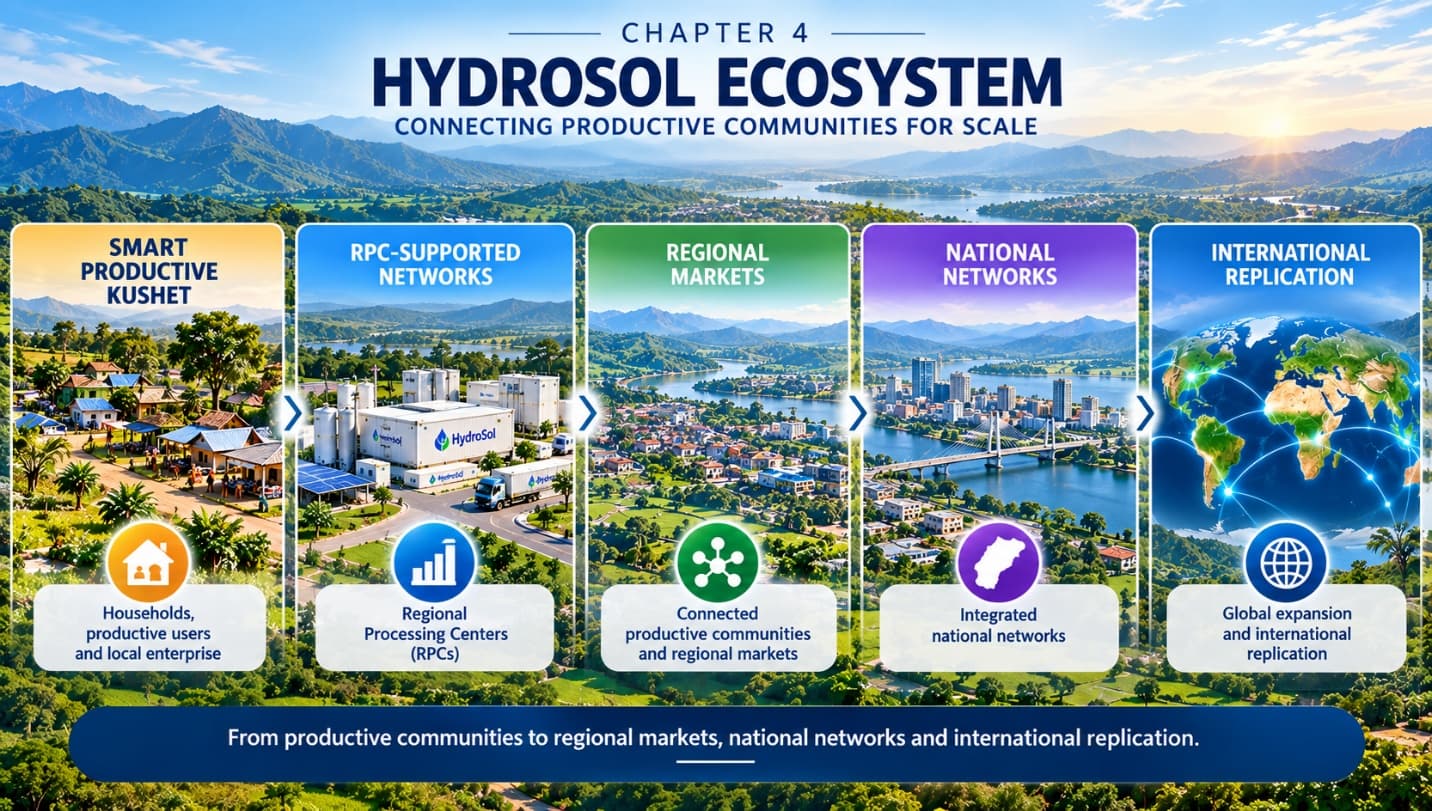
4.1 FROM PRODUCTIVE COMMUNITY TO SCALE
Smart Productive Kushet (ቁሸት — Community) — for planning purposes, a Kushet may encompass approximately 5,000–15,000 households, depending on settlement patterns, geography, productive activity, logistics and local conditions. The appropriate boundary and number of participating households should ultimately be determined with the community itself, reflecting local circumstances and priorities.
Smart Productive Kushet → RPC-Supported Network → Regional Market → National Network → International Replication
The scaling principle is: Replication → Clustering → Interconnection
This enables local productive markets to become building blocks within a wider commercial ecosystem.
4.2 A MULTI-REVENUE ECOSYSTEM
HydroSol is conceived not simply as a product-sale model, but as a multi-revenue Productive Energy ecosystem. Potential revenue pathways include:
Products & Equipment — SKU-2.5, SKU-12 and associated equipment.
Recurring Services — refill, recovery, regeneration and redeployment.
RPC Operations — processing, quality assurance, logistics and lifecycle services.
Productive Energy Services — including potential PAYGO and service-based models.
Commercial & Industrial Applications — agriculture, SMEs, processing, healthcare, thermal applications and productive mobility.
Manufacturing & Licensing — localization, co-manufacturing, authorized production and technology licensing.
Digital & Operational Services — monitoring, coordination and asset-management services.
Environmental & Climate Value — where independently verified and applicable.
Products → Recurring Services → RPC Operations → Productive Applications → Manufacturing & Licensing → Digital Services → Environmental Value
The potential model therefore combines initial product opportunities with recurring service, industrial and platform opportunities.
These remain potential revenue pathways subject to validation, market development, applicable regulation and commercial verification.
4.3 MARKET OPPORTUNITY
HydroSol's potential addressable population extends to approximately 2.3 billion people across infrastructure-constrained and underserved communities.
The scale of the opportunity can be understood through HydroSol's distributed architecture. Progressive deployment can create demand across three interconnected levels:
Households — deployment of SKU-2.5 and associated recurring services.
Smart Productive Kushets — deployment of SKU-12 for larger productive and community applications.
Regional Production Centers (RPCs) — industrial and lifecycle infrastructure supporting distributed deployment.
Together, these create a scalable commercial architecture extending from individual users to productive communities and regional networks.
Deployment Scale × Product Mix × Recurring Revenue × Productive Applications × Network Expansion = Addressable Economic Opportunity
This combination of a large potential deployment base and a multi-revenue ecosystem underpins HydroSol's preliminary assessment of a broader addressable opportunity exceeding:
USD 100+ BILLION
This represents a preliminary addressable-market assessment—not projected HydroSol revenue, company valuation or guaranteed market penetration.
Actual market size, product requirements, customer adoption and commercial performance will be progressively established through validation, deployment experience and market evidence.
4.4 FROM OPPORTUNITY TO BUSINESS
A large addressable market opportunity does not by itself create an investable business.
Commercial opportunity must be demonstrated through technology performance, customer demand, commercial economics and repeatability.
For detailed commercial, financial and investment information, please contact the HydroSol Team.
That leads to the next question:
How does HydroSol move from engineering readiness to commercialization and investment?
Explore Partnership →