
Chapter 1
THE QUEST TO BREAK THE POVERTY CYCLE
Beyond the Last Mile
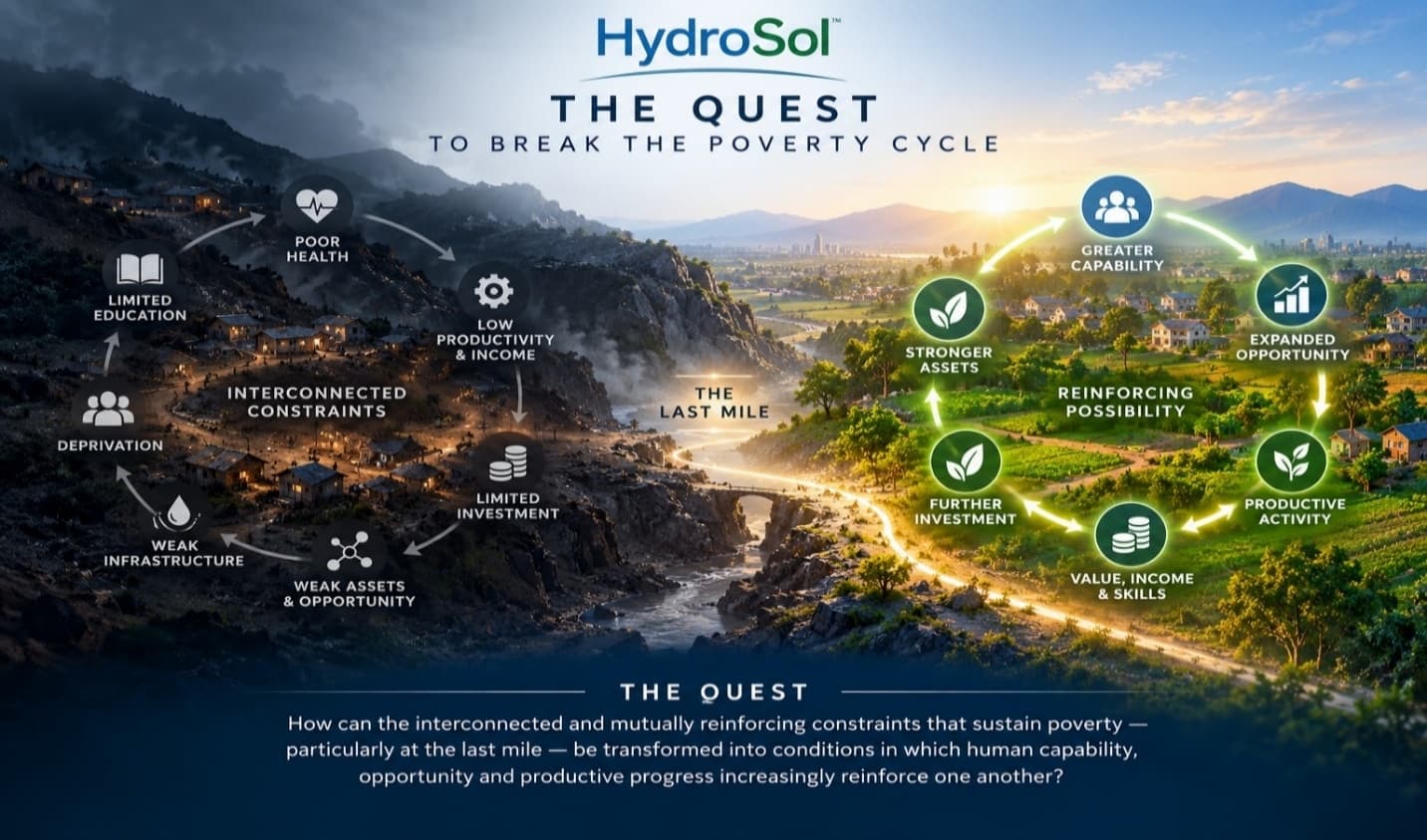
Poverty is one of humanity's oldest challenges—and one of the most difficult to define.
Over time, development thinking has moved from understanding poverty principally through what people lack toward a broader question:
What are people actually able to do and become?
1. ORIGINAL UNDERSTANDING OF POVERTY
For generations, poverty was understood largely through insufficient income and access to basic necessities, including food, shelter and other essentials.
These remain fundamental measures of human well-being. But income alone does not capture the full range of conditions that can limit people's lives and opportunities.
2. BROADER DEVELOPMENT UNDERSTANDING
Development thinking progressively broadened this perspective.
The World Bank complements monetary measures with other dimensions of deprivation, while multidimensional approaches associated with UNDP and Oxford examine overlapping disadvantages in areas such as health, education and living standards.
The capability approach associated with Amartya Sen extends the argument further: income and resources are important means, but development also concerns the real capabilities and opportunities people have to lead lives they value.
3. REGIONAL DEVELOPMENT PERSPECTIVES
Latin America's ECLAC emphasizes structural inequality and unequal access to opportunity, while the African Union's Agenda 2063 connects poverty eradication with inclusive growth, employment, human development and economic transformation.
Together, these perspectives show how the understanding of poverty has progressively widened:
Income → Basic Needs → Human Development → Capabilities → Multidimensional Deprivation → Structural Constraints → Transformation
Poverty is therefore not simply a shortage of income.
4. THE POVERTY CYCLE
A poverty cycle is a self-reinforcing process in which poverty creates conditions that make it difficult to escape poverty.
Low income, for example, can limit access to nutrition, healthcare, education, skills, productive assets and economic opportunity. These limitations can reduce the capacity to work, produce, earn and invest—reinforcing the original deprivation.
A poverty cycle can therefore be expressed simply as:
Deprivation → Restricted Capability & Opportunity → Low Productivity & Income → Limited Investment → Further Deprivation
The causes and pathways vary across people, communities and regions; there is no single mechanism that explains poverty everywhere.
There may be no single universal poverty cycle. Yet deprivation can still become mutually reinforcing.
5. INTERCONNECTED AND REINFORCING CONSTRAINTS
Poor health can restrict learning and work. Limited education can restrict employment and enterprise. Weak infrastructure can constrain productive activity. Limited market access can restrict the value created from production. Low productivity and income can, in turn, limit further investment.
This helps explain why improvement in one area, while valuable, may not always be sufficient by itself:
Electricity without productive use.
Education without opportunity.
Production without access to markets.
The deeper challenge is not simply to provide another isolated input, but to create conditions in which different gains can connect and begin to reinforce one another:
Capability → Opportunity → Productive Activity → Further Progress
6. BEYOND THE LAST MILE
The last mile is more than the final physical distance between infrastructure and the people it is intended to serve. In development, it can also be:
Physical | Economic | Institutional | Technological | Human
Services, knowledge and resources may exist without the affordability, reliability, skills, infrastructure, finance or market access needed to turn them into sustained local value.
The last mile may be where some of development's hardest connections must be made.
This leads to a fundamental question:
If deprivation can reinforce deprivation, can capability, opportunity and productive progress begin to reinforce one another?
How can the interconnected and mutually reinforcing constraints that sustain poverty—particularly at the last mile—be transformed into conditions in which human capability, opportunity and productive progress increasingly reinforce one another?
That is our Quest: to break the Poverty Cycle at the Last Mile.