
Chapter 2
THE HYDROSOL PLATFORM
WHAT EXACTLY HAVE WE BUILT?
2.1 FROM THE QUEST TO THE PLATFORM
The interconnected constraints and reinforcing poverty cycle explored in The Quest raised a practical question: how could these constraints begin to give way to productive capability, economic opportunity and sustained progress?
Across infrastructure-constrained markets in the Global South and elsewhere, households, farms, enterprises, healthcare facilities and other productive users require energy that is accessible, reliable, flexible and economically useful.
HydroSol emerged from this search for a practical solution and from a central question:
Can productive energy capability be brought closer to where productive activity and market demand actually occur?
HydroSol's development drew lessons from professional experience, scientific investigation, engineering disciplines, earlier energy experimentation and established energy pathways.
Because the challenge itself is interconnected, HydroSol has been developed through a multidisciplinary systems approach, bringing together scientific, engineering, operational, manufacturing, deployment, economic, institutional and development perspectives.
The result is the HydroSol Platform.
2.2 THE HYDROSOL PLATFORM
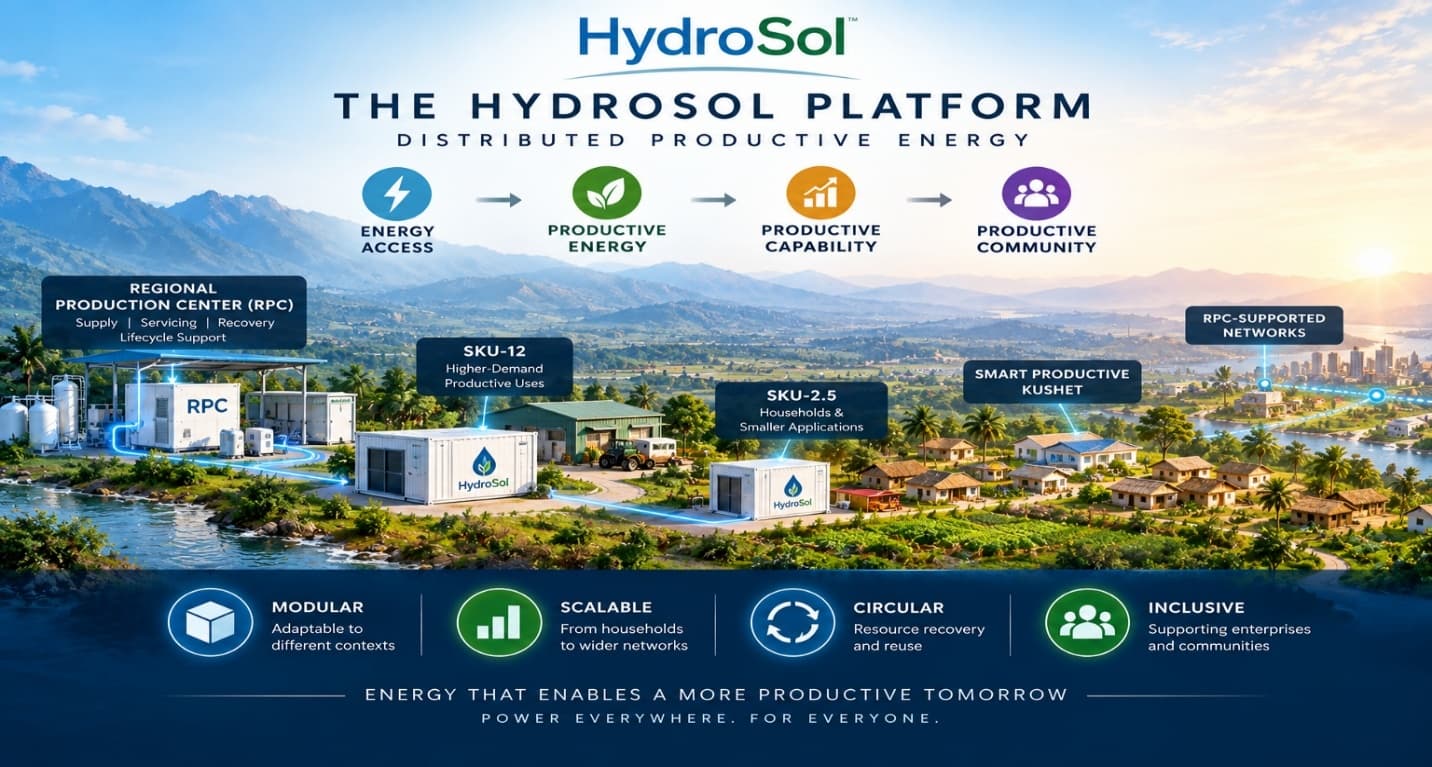
HydroSol is a new Hydrogen-on-Demand invention developed into a distributed Productive Energy platform designed to bring useful energy capability closer to the point of productive use.
THE ENERGY CAPABILITY TRAVELS TO THE USER.
The platform brings together five principal elements:
Hydrogen-on-Demand Generation — generation of hydrogen close to the point of productive use.
SKU-2.5 — a portable modular hardware platform primarily intended for households, micro-enterprises and smaller productive applications.
SKU-12 — a larger modular hardware platform intended for SMEs, agriculture, healthcare, productive mobility, thermal applications and community-scale productive uses.
Regional Production Centers (RPCs) — the industrial and lifecycle backbone supporting preparation, regeneration, quality assurance, logistics and redeployment, with each RPC intended to support approximately 150,000–250,000 households, depending on deployment density, logistics, productive demand and operating requirements.
Services & Digital Support — supporting logistics, monitoring, operational coordination and potential service and PAYGO models appropriate to different markets.
2.3 DISTRIBUTED BY DESIGN
HydroSol separates two complementary functions:
Productive Energy Close to the User ↔ Coordinated Industrial & Lifecycle Support Through RPCs
Productive-energy capability is distributed close to households, enterprises and other users, while selected industrial and lifecycle functions are coordinated through RPCs.
RPC functions may include:
Preparation | Regeneration | Quality Assurance | Inventory | Logistics | Training | Coordination | Redeployment
This architecture is designed to complement existing infrastructure, particularly where productive demand is growing faster than conventional systems can economically or practically extend.
2.4 CIRCULAR BY DESIGN
HydroSol is designed around a continuing operational cycle:
Preparation → Deployment → Productive Use → Recovery → Regeneration → Quality Assurance → Redeployment
The objective is not simply to deploy equipment, but to support its continuing productive use through an integrated lifecycle architecture.
2.5 PRODUCTIVE APPLICATIONS
Potential applications extend across:
Households | SMEs | Agriculture | Food Processing | Refrigeration | Healthcare | Workshops | Thermal Applications | Productive Mobility | Digital Services | Community Infrastructure
Hydrogen is therefore an enabler of productive activity rather than the end objective.
Productive Energy → Productive Capability → Economic Value
2.6 FROM PLATFORM TO PRODUCTIVE USE
Technology acquires value when people and enterprises can use it to produce, process, preserve, transport, communicate, manufacture or provide services.
That leads to the next question:
What can customers and productive users actually do with HydroSol?
Explore the Smart Productive Kushet →